
Calvary Presbyterian Church was founded in 1869 by prominent Milwaukee citizens John Plankinton, James B. Bradford, Samuel West, L. Kellogg, John Ogden, and John Currie. The first services were held in a frame building south of St. James Church.
The architects of the building were Julius Hess and Henry C. Koch. The 1870 construction was done by builder Simeon Babcock and mason Hirim R. Bond. The church is constructed of Ohio sandstone and Cream City brick which was painted red in 1887. Iron work was done by William Bayley and William Greensdale. John Harding painted the Frescoes.
The corner stone, which reads “1870,” was set in place May 10, 1871, as construction was behind schedule.
The stained glass windows were imported from France. They are unique in that they have no religious symbols in them. Everything in the sanctuary is original except for the floor and the sails. The light fixtures were originally gas, but were subsequently wired for electricity.
In 1910 a church office and pastor’s study were added to the southwest corner of the building, and in 1957 classrooms were added to the southeast corner of the building.
The Fire
At 6:00 pm on January 25, 1947, the custodian opened the building for regular choir practice. He noticed a light on in the pastor’s study, and went to investigate. Sometimes Rev. Lewis, the current pastor, worked late, and that was the case this evening. Since there had been a small fire some months before, the congregation was especially vigilant. Together, pastor and custodian made a security check of the building and found nothing. After the choir practice was over, they locked up and went home.
The fire was reported at 2:15 am when heat and flames blew out two of the windows on the south end of the building. The three-alarm fire was quickly brought under control, saving the structure. Firemen remained on the scene well past 6:00 am to make sure the fire was completely out. Fire investigators found two pairs of men’s pajamas and what appeared to be a women’s slip soaked in kerosene
wrapped around the stair railing where the fire had started.
Rev. Lewis was charged and later convicted of setting the fire.
The chancel area and the pipe organ were completely destroyed in the fire. The chancel was redone in a light colored oak, which is why it does not match the balcony. The pipe organ was replaced with a donation from a private home in Shorewood. Some of the trusses were burnt and needed plaster facing to make them match the rest of trusses.
In 1986, Calvary was placed on the National Registry of Historic Buildings.
The Renovation
Rev. Dee Talley was installed as minister at Calvary in 1994 when there were fewer than ten active members. In order to make the space more versatile and usable by such a small group, a bold renovation to the sanctuary was proposed. In 1996, architect Bill Hiltner was hired to remove the pews and install a new floor. The sails were added along with the labyrinth.
Labyrinths became associated with the Christian Church in the 12th century when it was not safe to make a pilgrimage to the Holy Land. Architects began to place them in cathedrals as a symbol of a journey to the Holy Land. The Calvary labyrinth is a copy of the ancient labyrinth in the Cathédrale Notre-Dame de Chartres in France.
In 1997, the Wisconsin Association of Architects awarded Calvary with one of three Excellence in Design Awards it gives out each year.
Now and Into the Future
In 2019, Rev. Mark McDonough left Calvary, and rather than forming a Pastoral Nominating Committee as is typically done, Calvary chose to chart a path forward without a pastor, instead being led by the Ruling Elders of its Session, with assistance from the Milwaukee Presbytery. After making a quick pivot to Zoom-based worship in the early weeks of the COVID-19 pandemic in 2020, Calvary doubled down on being a place of refuge and radical acceptance, embracing discussion groups in addition to sermons and recording music to share over Zoom. Once able to worship in person again, Calvary continued to embrace a hybrid model of worship, attracting members from as far away as Nigeria.
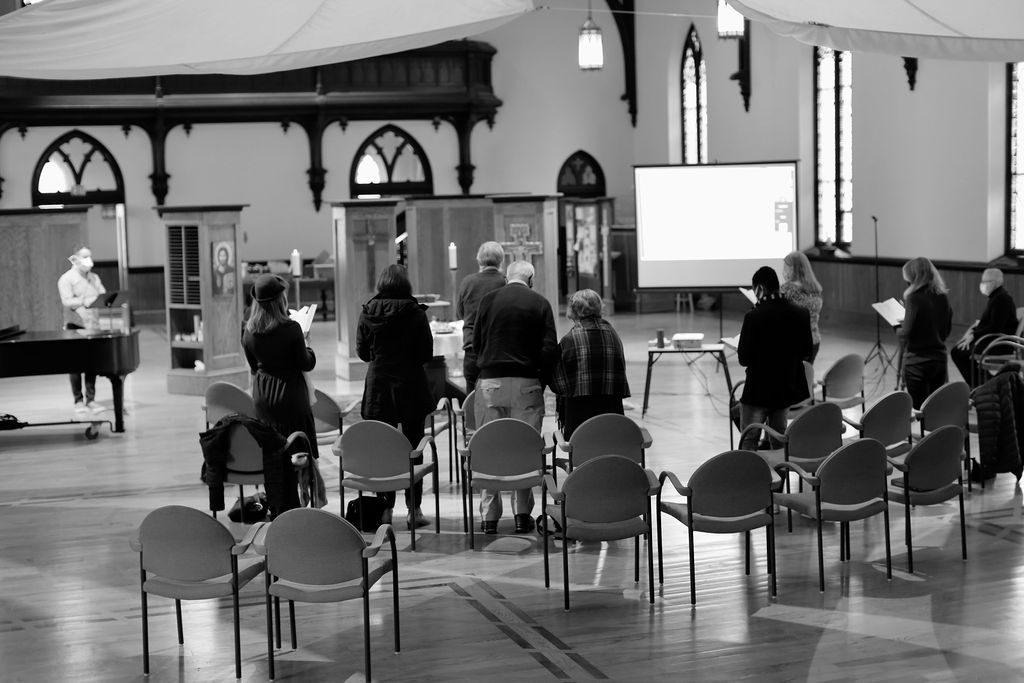
 Calvary Presbyterian Church